Research Brief
Housing
May 2026

Softening Single-Family Sales Creates
Potential Tailwind for Apartments
Inflation a headwind. Mortgage rates climbed back above 6.5 percent in late May as inflationary pressures built. Ongoing disruptions to global shipping have kept energy prices elevated. In turn, April’s consumer price index rose 3.8 percent year-over-year, the highest reading since May 2023. A Pentagon assessment warns that fully clearing Iranian naval mines from the Strait of Hormuz could take several months after the conflict formally ends, suggesting upward pressure on oil prices may persist. With elevated energy costs likely to remain through much of the year, inflationary pressures may continue to complicate the outlook for monetary policy. As such, the Federal Reserve held rates steady at its May meeting, while Wall Street has now priced in a meaningful probability of a rate hike before year-end.
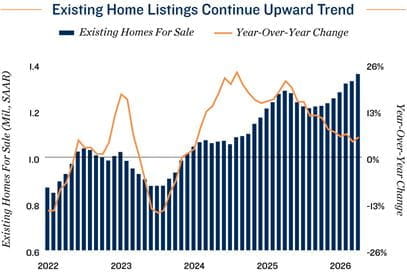
Borrowing costs weigh on demand. Because mortgage rates are closely tied to monetary policy expectations, prediction markets are now pricing in nearly even odds that the 30-year fixed rate surpasses 6.8 percent before year-end, with a roughly one-in-four chance it reaches 7.0 percent. Should borrowing costs continue to rise, affordability pressures will intensify, weighing on home sales at a time when market conditions are already softening. Seasonally adjusted existing home sales in April remained nearly 25 percent below the monthly average recorded between 2015 and 2019, while the median existing home sale price has declined nearly 2 percent through the first four months of 2026. At the same time, the number of existing homes for sale continued to climb, reaching its highest level since 2020, suggesting available inventory is accumulating as elevated financing costs suppress buyer activity and extend listing durations.
Reduced homebuying bodes well for multifamily. Sustained softening in single-family affordability could translate into stronger rental leasing, particularly in markets with especially high homeownership costs. Coastal gateway metros, alongside West Palm Beach, Miami, Milwaukee, Cincinnati, and Indianapolis, have recorded some of the nation’s largest increases in home price-to-income ratios over the past five years, while also experiencing substantial widening in the affordability gap between renting and owning. For multifamily operators and investors concentrated in these metros, continued pressure on mortgage rates may prove to be a tailwind.
Construction Trends
Pending legislation impacts development outlook. The number of permits issued in April on a seasonally adjusted annual basis fell to its lowest level since last August, highlighting the increasingly challenging environment for housing development. Against this backdrop, the 21st Century ROAD to Housing Act has emerged as a key variable for future construction activity. The bipartisan legislation aims to address the nation’s housing shortage by expanding supply incentives and streamlining portions of the federal development process, potentially easing barriers for builders over time.
Multifamily development slows. Apartment completions are set to decelerate for the third consecutive year in 2026. Total inventory across the U.S. is forecast to expand by just 1.3 percent, marking the slowest pace of growth since 2013. Nearly four-fifths of all major markets are expected to see slowing new supply year-over-year, with Austin, Charlotte, San Jose, Nashville, and Raleigh forecast to record the sharpest pullbacks.
0.3% |
5.5% |
|
Decrease in existing homes |
Decrease in single-family |
Sources: Marcus & Millichap Research Services; Moody’s Analytics; National Association of
Realtors; RealPage, Inc.; Freddie Mac; Federal Reserve Bank of St. Louis; Mortgage Bankers
Association; National Association of Home Builders; U.S. Census Bureau
TO READ THE FULL ARTICLE