Research Brief
Employment
May 2026

Resilient Job Growth Supports CRE; Bright Spots Despite Mounting Risks
Employment gains face uncertain outlook. April’s jobs report showed hiring held firm, with the creation of 115,000 positions, more than doubling the consensus estimate and marking the first back-to-back monthly increase since last year in March and April. However, job growth stayed selective. Gains were concentrated in health care and defensive-leaning categories, including trade, transportation and utilities, while discretionary and cyclical industries were softer. The report may also not yet capture the recent oil price shock, since hiring decisions adjust with a lag. Strong retail sales suggest households are drawing on savings to support spending, but prolonged gas price pressure could slow consumption and weigh on business activity. Even where demand holds, tighter labor availability may limit expansion in select industries, as the labor force fell by 92,000 people in April.
Labor constraints lift blue-collar wages. Reduced immigration and falling participation among young workers may be limiting labor supply in sectors like construction and manufacturing. Construction unemployment fell 180 basis points year-over-year to 3.8 percent in April, while manufacturing unemployment declined 30 basis points to 3.3 percent. Some employers appear to be responding with higher pay, as both sectors posted average hourly earnings growth above 4 percent. While this could limit tenant expansions, stronger blue-collar wage growth may support workforce housing demand. Class C apartment vacancy held at 5.0 percent in March and reclaimed the lowest rate among classes after rising just 10 basis points year-over-year, compared with 30-basis-point jumps at Class A and B properties
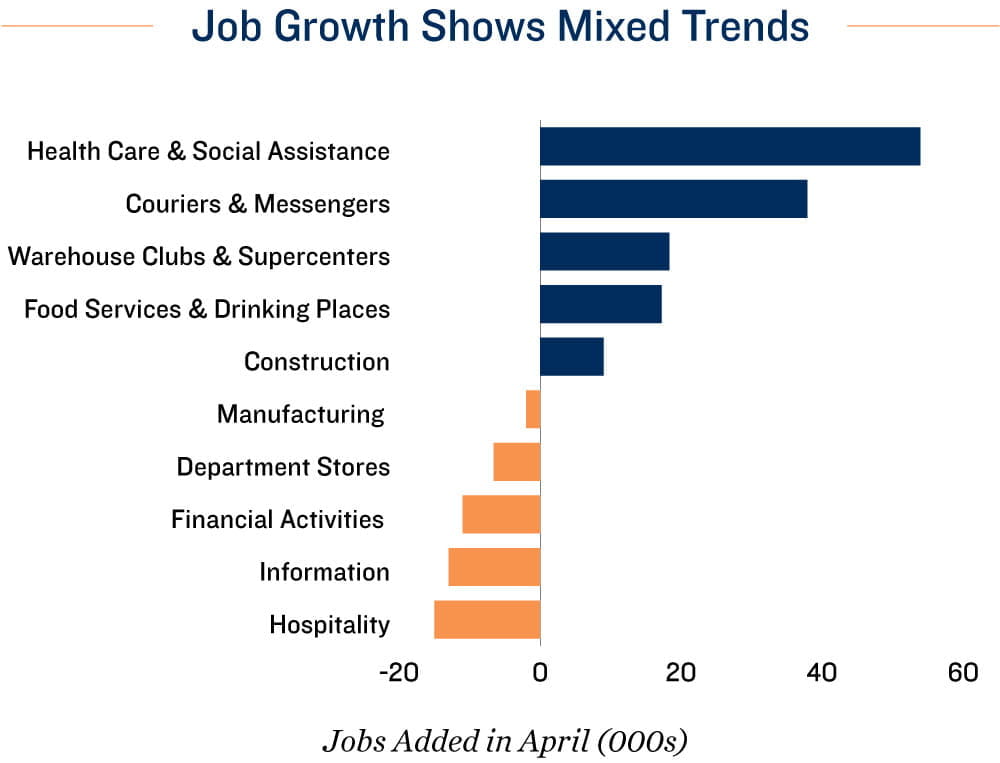
Soft white-collar hiring spotlights office use. Aging demographics are adding pressure to an already limited skilled-labor pool. Unemployment stood at 3.8 percent in information and 2.7 percent in financial activities in April, with both rates falling year-over-year despite sector job losses. This may keep employers focused on mentorship and office engagement, potentially lifting utilization as April marked the third-busiest in-office month since COVID-19. More in-office work could also fuel CBD apartment demand, where vacancy held flat at 4.7 percent over the past year while suburban vacancy rose. With first-quarter CBD deliveries falling below 10,000 units for the first time on record, supply trends further favor stronger fundamentals.
Oil Shock Shifts Hiring
E-commerce supports 3PL demand. Couriers and messengers were among April’s strongest job categories, adding 38,000 roles. This likely reflects e-commerce growth, which may prove resilient amid higher gas prices as consumers cut back on store trips. Third-party logistics activity should also grow as firms look to streamline distribution, as illustrated by Amazon opening its logistics network to outside companies. This should support large-format distribution demand, after buildings over 500,000 square feet posted the strongest quarterly net absorption since 2022 in the first quarter of 2026
Daily routines fuel QSR growth. Value-oriented retailers and quick-service concepts may stay better positioned as consumers seek lower prices while preserving routine, small-ticket purchases. April’s job gains support that pattern, as warehouse clubs and supercenters added 18,000 roles, while food services and drinking places added 17,000 jobs. Repeat spending at concepts like Dutch Bros and Starbucks should help sustain record quick-service expansion, where construction topped 1 million square feet and investment volume neared $300 million over the year ended in March, both all-time highs.
304,000 |
4.3% |
|
Jobs Created Year-to-Date through April 2026 |
Unemployment Rate as of April 2026 |
Sources: Marcus & Millichap Research Services; Bureau of Labor Statistics; CME Group; CoStar Group, Inc.; Federal Reserve; Moody’s Analytics;
Placer.Ai; RealPage, Inc.; U.S. Census Bureau
TO READ THE FULL ARTICLE