Research Brief
Canada Housing
May 2026

Housing Market Stabilizing, Yet Borrowing Cost Pressures Linger
Residential market may be turning a corner. Canada’s housing market showed tentative signs of stabilization in April, as the median price of a single-family home edged up marginally on a monthly basis for the first time in more than a year. While the price still fell 3.4 per cent year-over-year, the monthly rise suggests pricing may be improving. This comes as home sales also rose 0.7 per cent monthly, due in part to fewer days on market. That said, the national sales-to-new listings ratio declined to 45.6 per cent as new listings rose faster than sales, indicating that market conditions remain relatively balanced to-soft. As a result, while pricing appears to be stabilizing in the near term, the current supply-demand backdrop suggests any meaningful pricing momentum may take some time to materialize.
Higher mortgage rates may temper demand. Escalating conflict in the Middle East has renewed inflation concerns, pushing government bond yields and fixed-rate mortgage rates higher. Rising borrowing costs are likely to further dampen housing demand and limit any meaningful near-term rebound in home prices, particularly as affordability challenges remain elevated. Even so, persistently high ownership costs continue to keep many potential buyers in the apartment rental market, supporting multifamily fundamentals despite some recent softening. While rental demand has moderated from the exceptionally strong levels recorded during the post-pandemic immigration surge, elevated mortgage costs are still prompting many households to delay homeownership.
Commercial Real Estate Outlook
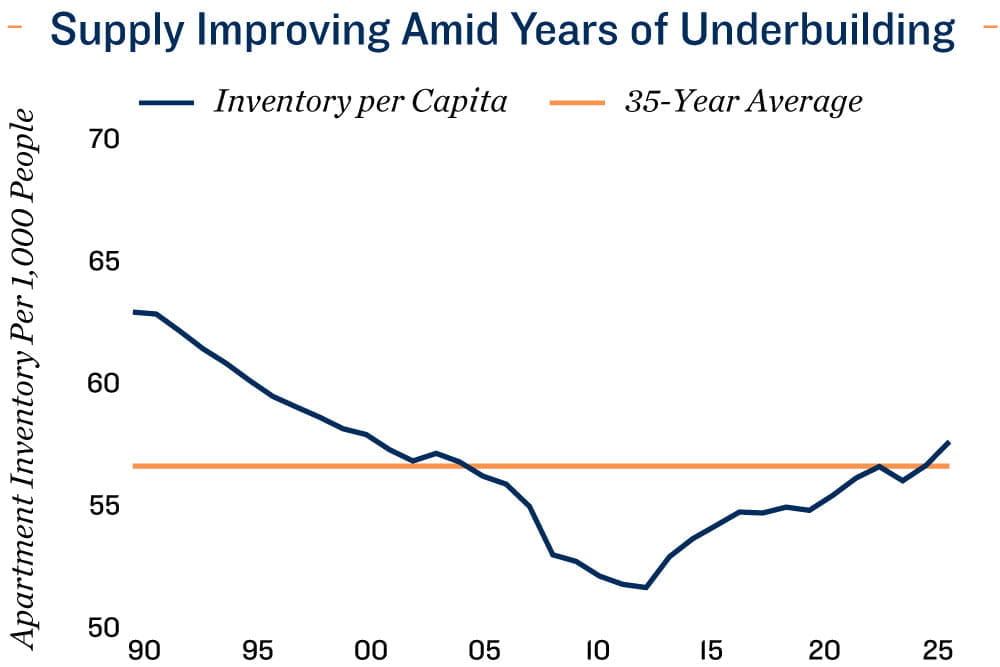
Supply pressures persist. Weak condo and pre-construction demand may slow housing starts in the near term. Elevated financing and construction costs, combined with softer investor demand, are challenging project feasibility, particularly in major markets such as Toronto and Vancouver. At the same time, the recent wave of new purpose-built apartment supply and the pullback in immigration have eased rental market conditions. That said, government policy — including first-time buyer incentives, favourable CMHC financing, the removal of GST/HST on qualifying projects, and waived development charges in Ontario — should partially offset these softening demand-side dynamics and help spur some new development.
Long-term housing dynamics are strong. Despite softer near-term housing demand and mild construction pressure, Canada’s longer-term fundamentals remain sound. Population growth, while slower than the unprecedented pace of the past several years, continues to outpace new housing completions in many markets. Meanwhile, years of underbuilding have contributed to a persistent housing shortage. At the same time, affordability challenges continue to delay homeownership. Consequently, even as rising supply and softer economic conditions place some downward pressure on rents and home prices in the near term, longer-term demand for both ownership and rental housing should continue, particularly once borrowing costs stabilize more meaningfully and population growth returns to the long-term average by 2028.

* Through April Sources: Marcus & Millichap Research Services; Altus Data Solutions; Capital Economics; CMHC; CoStar Group, Inc.; CREA; Oxford Economics; Statistics Canada
TO READ THE FULL ARTICLE