Research Brief
Iran Conflict and CRE Outlook
April 2026

Rising Global Tensions Add
Complexity to Path Forward for CRE
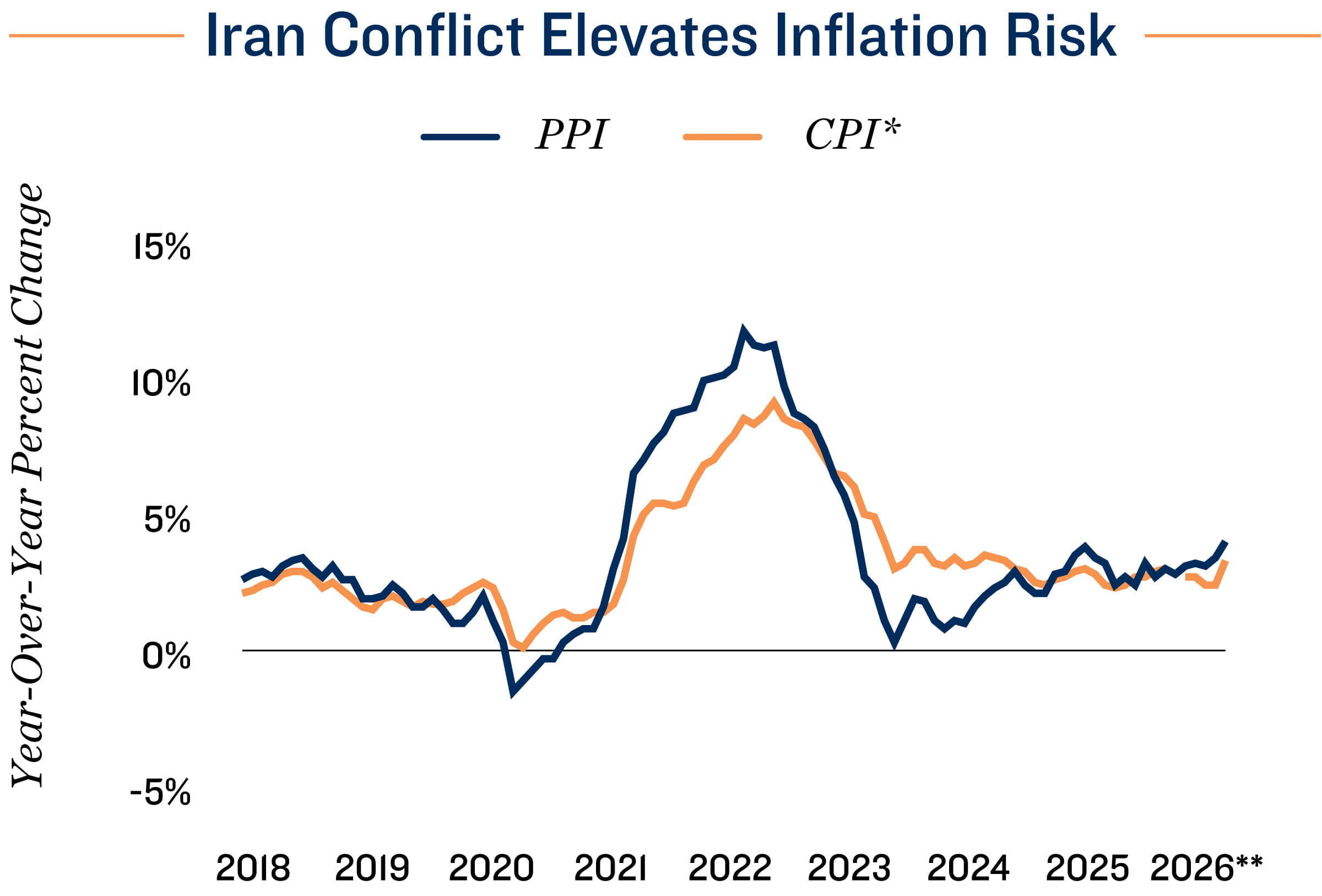
Geopolitical shock reignites inflation risk. The Middle East conflict has pushed up prices for key commodities and transportation, contributing to renewed inflation pressures.
- Elevated oil and gas prices are the most visible economic impact of the conflict, but higher costs for other commodities transiting the Strait of Hormuz also pose potential headwinds.
- Since late February, prices for fertilizer components, critical to agricultural production, have increased more than 50 percent.
- Helium prices, an essential input for semiconductor and electronics manufacturing, have risen by 10 to 20 percent.
- Likewise, transpacific shipping costs have increased roughly 35 percent, while flatbed trucking rates used to move shipping containers across the U.S. are up approximately 26 percent.
- The March CPI rose to 3.3 percent, an 85-basis-point rise from February and the largest single-month gain since 2021.
- The March PPI climbed 60 basis points to 4 percent, signaling rising input costs for manufacturers and other businesses.
Policy trade-offs intensify. Diverging economic signals are shifting market expectations and narrowing the Federal Reserve's room to maneuver
- Rising fuel costs and persistent uncertainty have weighed on consumer sentiment, which fell to a record low in March, while job creation remains well below historical norms.
- Elevated inflation risk and slowing economic growth are making the Fed's policy decisions increasingly complex.
- Policymakers face competing pressures to maintain higher rates to curb inflation while also considering rate cuts to support economic activity.
- Financial markets are currently pricing a 30 percent chance of at least one rate cut by year-end, a sharp contrast from earlier this year when Wall Street was calling for up to three cuts.
- Shifting rate expectations following the conflict pushed the 10- year Treasury yield nearly 50 basis points higher to around 4.4 percent before stabilizing near 4.3 percent at the start of April.
CRE's strategic role strengthens. The asset class continues to serve as a diversification tool, an inflation hedge, and a hard asset with durable value retention, especially during uncertainty.
- Commercial real estate lenders widened their rate spreads as the 10-year Treasury yield rose.
- As Treasury yields stabilized, lender caution eased, returning borrowing costs to late-2025 levels.
- Bank lending rates for commercial assets have reverted to the low- to mid-6 percent range, while agency-backed multifamily financing has settled in the mid-5 percent band, suggesting CRE transaction velocity should sustain momentum.
- Capital flows into CRE-targeted funds increased 36 percent in 2025 from 2024, with an estimated $285 billion of undeployed capital targeting the sector.
- Competitive yields, durable cash flows, and inflation-hedging characteristics are increasing CRE's appeal, further reinforced by financial market volatility and rising inflation.
- Last year, commercial property transactions over $2.5 million rose 17.3 percent, and the Mortgage Bankers Association projects a 15 percent rise in CRE lending activity in 2026.
- These dynamics suggest an optimistic outlook for CRE in 2026.
* October 2025 CPI data not published ** Through March 2026
Sources: Marcus & Millichap Research Services; Bureau of Labor Statistics; CME Group; DATS
Analytics; Freightos Limited; IMARC Group; Mortgage Bankers Association; Preqin; Real Capital
Analytics; University of Michigan; U.S. Federal Reserve; World Bank
TO READ THE FULL ARTICLE