Research Brief
Retail Sales
April 2026

Consumer Spending Barrels Ahead, Despite Historic Rise in Fuel Costs
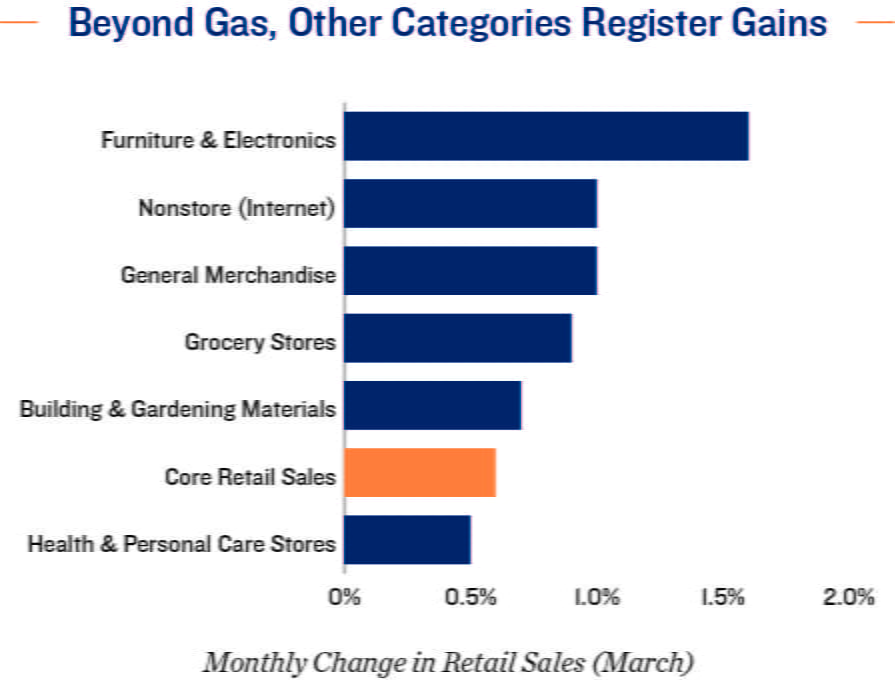
Core retail sales up in real terms. Consumers continue to exhibit resiliency, this time in the face of historically high gas prices, which rose 21.1 percent in March after Strait of Hormuz closures. As such, core retail sales, which exclude auto and gasoline purchases, rose 0.6 percent last month, contributing to a 4.2 percent year-over-year improvement in spending. Moderate movement in the core CPI was noted last month, up 0.2 percent, suggesting that elevated fuel costs had yet to pass through to consumer products. Moving forward, however, pressure could emerge. Early this week, Washington announced an extension of the current ceasefire agreement with Iran; however, port blockades remain in place, which may impede negotiations and keep oil prices elevated moving forward. Additionally, U.S. wage growth continued to moderate in March, with average hourly earnings rising just 0.3 percent over the past year when adjusting for inflation.
Spending reflects shifting consumer behavior. More households are purchasing necessity and household items in bulk to save money amid persistent inflation. General merchandise stores, which include warehouse clubs, are benefiting most from this dynamic. Last month, sales were up 1.0 percent, marking the retail segment’s largest gain in two years. Amid rising membership levels and notable sales growth, Sam’s Club, Costco, and BJ’s Wholesale Club are plotting expansion, with each planning to open 15 to 25 new locations this year. These growth initiatives will primarily be achieved by backfilling existing spaces, a boon for single-tenant leasing activity above 100,000 square feet.
Refunds provide a respite. The retail sector faces challenges in the coming months; however, larger federal income tax returns may help alleviate the impact on consumer spending. This year’s average refund of $3,462 was 11 percent higher than last year, with many households receiving refunds $500 to $1,000 larger than in prior years. This should add to real GDP growth, as it gives households extra cash for discretionary purchases or debt payments.
 Favorable fundamentals remain intact. Retail vacancy rose 20 basis points from December 2025 to March 2026; however, the sector’s rate remained below 5.1 percent for an 18th straight quarter. While net relinquishment occurred across the single- and multitenant sectors, both property types entered April with vacancy at least 70 basis points below their long-term average. Additionally, a broad pullback in construction will limit supply-side pressure for the remainder of this year, which should aid vacant properties in their pursuit of tenants.
Active marketplace exists. The retail sector noted a 21 percent increase in deal flow over the 12 months ending this March, compared with the prior yearlong interval. The single-tenant segment recorded a more pronounced gain, indicating that the pool of investors seeking less management-intensive assets may be on the rise. This month, Apollo Global Management announced it would invest $1 billion for a 49 percent stake in a Realty Income portfolio of single-tenant, net-leased properties.
4.2% |
0.6% |
|
Year-Over-Year Rise in Core Retail Sales |
March Increase in Core |
Note: Core retail sales exclude auto and gasoline purchases
Sources: Marcus & Millichap Research Services; CoStar Group, Inc.; Internal Revenue Service; U.S.
Bureau of Labor Statistics; U.S. Census Bureau
TO READ THE FULL ARTICLE