Research Brief
Labor Market Influencers on CRE
April 2026

Slowing Job Creation Shifting Perspectives on Space Needs
Employment growth is weakening. Although the economy continues to expand at a moderate pace, job creation has moderated along with labor force participation.
- An estimated 178,000 positions were added in March, the strongest monthly figure since December 2024, assuming the Bureau of Labor Statistics does not revise the number down.
- Employers created an average of 22,000 jobs per month during the year ended March, compared to a mean of 122,000 new roles per month in 2024 and 210,000 in 2023.
- Fewer sectors are hiring, with most of the recent job creation focused in health care. There have also been nominal gains in local government, accommodations, food services, arts, entertainment, and financial services.
- The unemployment rate, meanwhile, has been relatively stable at 4.3 percent in March, largely due to a 60-basis-point year-over-year drop in labor force participation to 61.9 percent.
- Declines were steepest for those over age 55 or between 20 and 24, where rates decreased by 100 and 140 basis points, respectively.
Labor trends pose significant implications for multifamily. Slowing job creation and declining workforce participation among young adults have been weighing on renter demand.
- Net absorption in the first half of 2025 averaged 191,000 apartments per quarter, before slowing to 35,000 units in the third quarter, while 40,000 doors were relinquished to end the year.
- The number of young adults living with family has risen to a record high, surpassing even pandemic-era levels.
- History, nevertheless, indicates that when young adults move in with family, it is usually temporary.
- In the two years following the pandemic, the number of young adults living at home declined by nearly 2 million, contributing to the net absorption of about 665,000 units in 2021.
- As more young adults begin to find career-track jobs, apartment demand momentum could climb quickly.
Office, retail, and industrial properties less affected. Recent labor market dynamics have had a less noticeable impact on other commercial property types.
- Office space net absorption has been positive for seven consecutive quarters through the end of 2025, with primary markets capturing 53 percent of that new demand, compared to 20 percent and 26 percent in secondary and tertiary metros.
- Over those seven quarters, suburban office space was favored, capturing 63 percent of total net absorption.
- From a quality perspective, tenants gravitated toward Class A offices, which captured more than 71 percent of the new space filled, with Class B and C properties participating in the rest.
- The slackening pace of job creation has also had little effect on demand for retail and industrial space, with tariffs a much more immediate consideration.
- After brief dips into negative territory when new tariffs were announced last spring, demand for retail and industrial space increased again in the second half of 2025.
- Overall, recent labor market trends have had the greatest impact on multifamily, although rental demand has not been lost, just postponed. Apartment leasing is poised to increase once the job market strengthens.
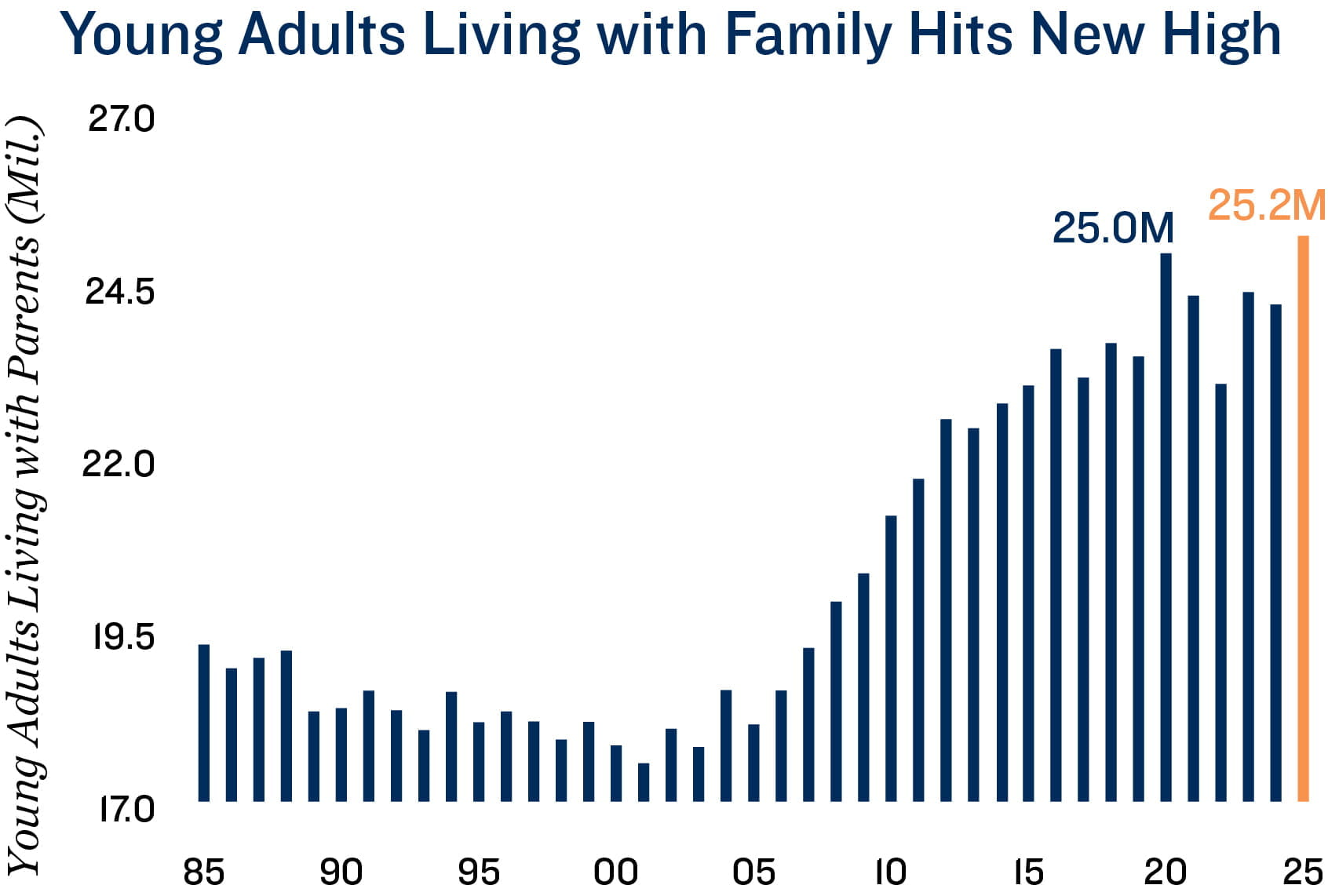
Notes: Young adults are between the ages of 18 and 34. Unmarried college students living in
dormitories are counted as living in their parents' home.
Sources: Marcus & Millichap Research Services; U.S. Census Bureau
TO READ THE FULL ARTICLE