Interest Rates Hold Firm Despite the Oil Shock as CRE Navigates Spillover Effects
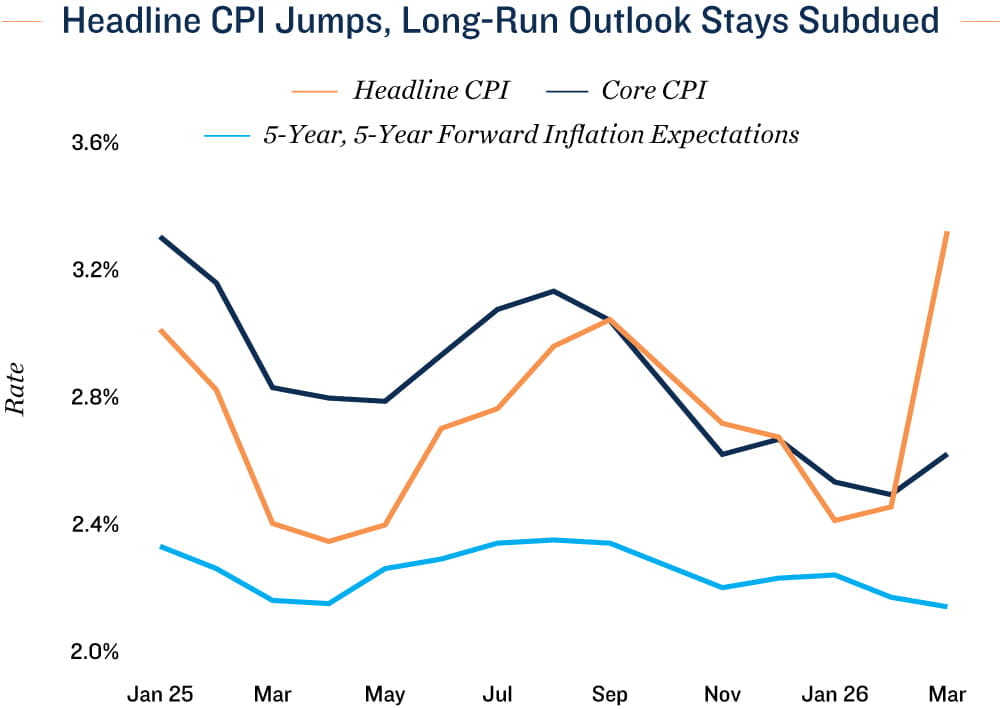
Record gas spike amid persistent tensions. The March CPI report captured the initial effect of the oil shock from the Strait of Hormuz closure, with the headline rate rising 0.9 percent month-over-month to 3.3 percent annually. Gasoline prices increased 21.2 percent on the month, the largest monthly gain since recordkeeping began in 1967. A two-week ceasefire announced earlier this month briefly eased oil prices, but talks between the U.S. and Iran stalled over the weekend, and Washington moved ahead with a blockade on traffic to and from Iranian ports. While the ceasefire has not fully collapsed, tanker traffic remains limited and oil prices have climbed back above $100 per barrel, leaving the outlook tied to whether energy flows normalize or disruption deepens. For now, pass-through into other consumer products remains minimal, with core CPI rising just 0.2 percent in March, though additional pressure could emerge in coming months.
Fuel volatility favors infill logistics assets. Some categories did show modest pass-through in March, including delivery services, which rose 3.1 percent month-over-month. The increase may mark an early sign of higher transportation costs reaching end users, as industrial tenants with heavy trucking exposure, such as third-party logistics firms and last-mile distributors, face higher fuel expenses. Elevated diesel and gasoline costs may pressure margins and delay expansion while tenants wait for more clarity on the Iran conflict. This dynamic could also reinforce the appeal of infill properties, where shorter routes, quick interstate access, and dense delivery networks help limit transportation costs. Even if the conflict is resolved, the recent volatility underscores the value of industrial space in population centers.
Natural gas stability keeps multifamily expenses in check. Despite the Strait of Hormuz carrying nearly one-fifth of global LNG trade, natural gas pressure remained muted in March as strong U.S. production helped shield domestic prices, with household natural gas costs falling 0.9 percent on the month. Limited pressure on natural gas prices should help keep multifamily expenses contained through both heating and power costs, as natural gas still fuels much of U.S. electricity generation. Apartment expense data also suggest operating costs are easing, with expenses per unit down 3.9 percent year-over-year in March, driven by lower taxes and insurance. Still, a sustained rise in oil prices could strain household budgets, especially among lower-income renters, and modestly weigh on apartment demand.
Hospitality momentum faces travel cost headwinds. Certain hotel metrics are strengthening despite the Iran conflict. RevPAR rose 2.4 percent over the first two months of the year, and preliminary March results point to further acceleration, with the industry on pace to record the highest number of rooms booked in any first quarter on record. Nevertheless, the oil shock has raised jet fuel costs, and the 2.7 percent increase in airline fares in March may suggest some of that pressure is reaching travelers. Higher ticket prices could temper discretionary travel and slow bookings, while elevated gas prices also make road trips more expensive.
Long-term rates hold despite market volatility. After the ceasefire deal, Wall Street’s forecast for at least one rate cut in 2026 roughly doubled to about 23 percent, though that outlook grew less certain as Iran talks deteriorated. Even so, the Fed’s latest projections still pointed to at least one cut in 2026, while five-year, five-year forward inflation expectations continue to fall, suggesting markets see the disruption as a temporary price spike rather than a lasting inflation shift. That may encourage the Fed to look through the oil shock, though policymakers will likely wait for more clarity on the conflict. Despite policy uncertainty, long-term interest rates have stayed relatively contained, supporting CRE investment activity
3.3%
|
2.6%
|
|
Increase in Headline CPI
Year-Over-Year
|
Increase in Core CPI
Year-Over-Year
|
Sources: Marcus & Millichap Research Services; Bureau of Labor Statistics; CME FedWatch; CoStar
Group, Inc.; Federal Reserve; RealPage, Inc.