Research Brief
Canada Retail Sales
April 2026

Shifts in Retail Spending Reinforce
More Balanced Commercial Real Estate Outlook
Consumption holds strong, but momentum under pressure. Retail sales volumes rose 0.3 per cent month-over-month in February, slightly below expectations but still pointing to a resilient consumer backdrop. In value terms, sales increased 0.7 per cent, supported by broad-based gains across discretionary categories, including motor vehicles, apparel, and general merchandise. However, weakness persisted in housing-related segments, with declines in building materials and home furnishings reflecting ongoing softness in residential activity. Overall, while February’s figures suggest consumption continues to support economic growth, the modest gain indicates a slightly softer contribution to first-quarter GDP than previously expected.
March pullback in spending reinforces rate hold. Preliminary estimates indicate retail sales rose just 0.6 per cent in March, a muted increase given a sharp 19 per cent surge in gasoline prices. Adjusting for price effects, sales volumes likely declined by roughly 1 per cent month-over-month, the weakest reading in at least six months. While first-quarter consumption is still tracking near a solid 4 per cent annualized pace, the weak month-end handoff suggests second-quarter growth will markedly slow. Coupled with declining consumer sentiment, this supports the view that household spending will moderate in the near term, reinforcing expectations that the Bank of Canada will maintain a cautious, hold-oriented stance as it assesses the durability of economic momentum.
Commercial Real Estate Outlook
Consumers remain in a more defensive position. Essential categories continue to drive the broader retail landscape. Consumers are becoming more cautious with their spending, increasingly focusing on necessities rather than optional goods. This trend is likely to persist in the near term, particularly as higher gasoline prices — driven by the ongoing Middle East conflict — place added pressure on household budgets. This will limit the upside for discretionary retail segments and reinforce a more subdued consumption outlook. As a result, grocery-anchored, essential-based retail should remain a preferred investment option.
Online spending aligns with stabilizing industrial fundamentals. E-commerce sales declined 0.6 per cent monthly in February, though remained up 2.2 per cent on an annual basis. This points to online spending continuing to normalize, with penetration rates holding relatively steady. For Canada’s industrial property sector, the trend is consistent with broader fundamentals, where vacancy has stabilized around 3.6 per cent and asking rents have levelled off in the $15.00 per square foot range amid dwindling supply-side pressures. Together, these dynamics signal a transition toward more balanced market conditions, with occupier demand shifting from rapid expansion to more selective, efficiency-driven leasing, while still supporting longterm demand for well-located logistics space. As a result, high-quality industrial continues to generate positive investor sentiment.

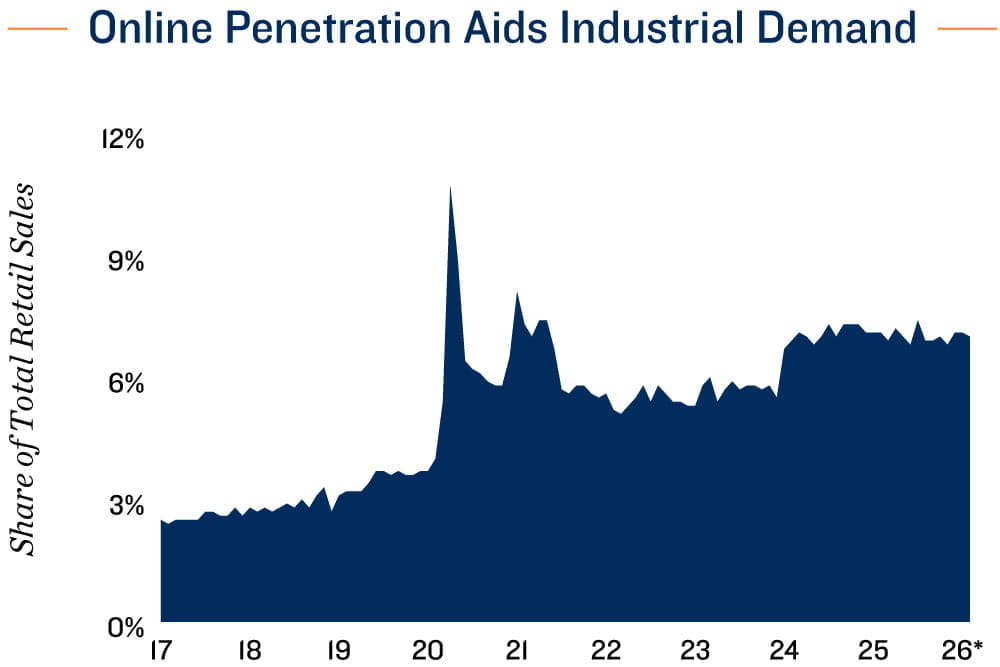
* Forecast provided by Oxford Economics
Sources: Marcus & Millichap Research Services; Altus Data Solutions; Capital Economics; CMHC;
CoStar Group, Inc.; Oxford Economics; Statistics Canada
TO READ THE FULL ARTICLE