Research Brief
Canada Inflation
April 2026

Inflation Volatility Tests CRE, but Long-Term
Rate Stability Expected to Return
Energy-driven inflation behind accelerated price growth. Canada’s headline inflation rate moved higher in March, with the Consumer Price Index rising 2.4 per cent year-over-year, up from 1.8 per cent in the prior month. A sharp increase in energy prices largely drove the acceleration, as gasoline costs surged amid the ongoing conflict in the Middle East and its implications on key global shipping routes such as the Strait of Hormuz. Energy alone contributed roughly 0.7 percentage points to the annual inflation rate, highlighting how geopolitical tensions — not underlying domestic demand — are currently shaping price pressures. While food prices also rose modestly, the broader inflation backdrop remains heavily influenced by volatile, externally driven factors.
Core inflation is anchored, supporting steady rate outlook. Despite the rise in headline inflation, underlying price pressures remain well contained, with the Bank of Canada’s preferred core measures — CPI-trim and CPI-median — rising just 0.18 per cent on average in March. On a three-month annualized basis, this equates to a 1.6 per cent pace, comfortably in line with the Bank’s 2.0 per cent goal and indicative of target-consistent inflation. As a result, policymakers are likely to look through the recent energy-driven volatility in headline figures, focusing instead on the more subdued core trend. With underlying inflation remaining anchored and economic growth still soft, the Bank of Canada is expected to maintain its overnight rate at 2.25 per cent through the near term, reinforcing a period of monetary policy stability.
Commercial Real Estate Outlook
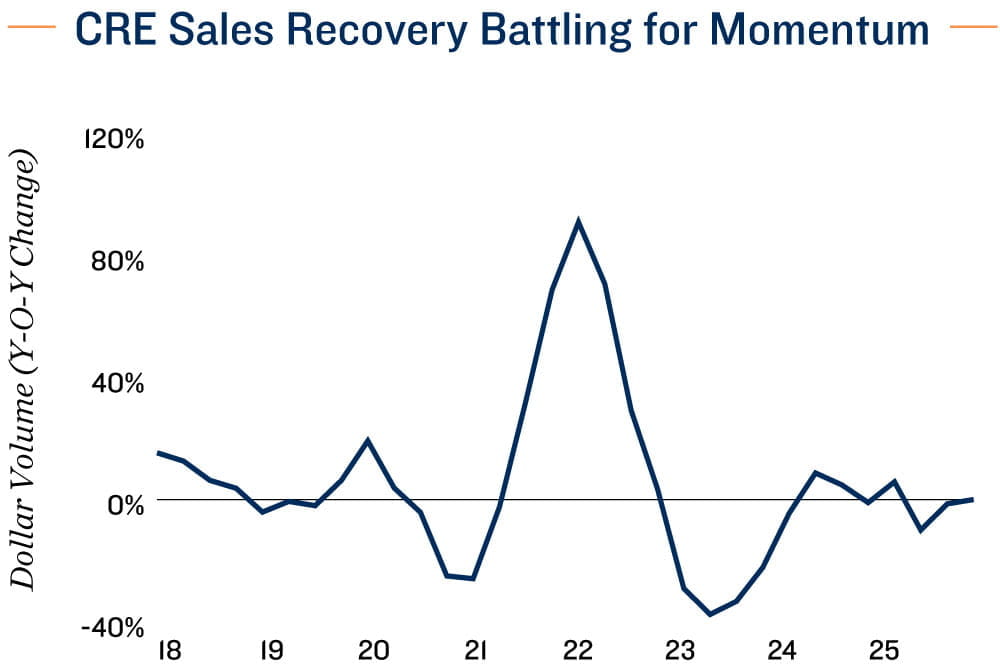
Bond volatility weighing on investment recovery. While improving rate stability has supported a gradual rebound in commercial real estate transaction activity — with dollar volume rising since April 2025 and stabilizing after three years of decline — renewed inflation risks tied to the Middle East conflict have introduced volatility into longer-term borrowing costs. Although the Bank of Canada is expected to hold its overnight rate steady, upward pressure on five- and 10-year bond yields has increased mortgage rates, creating near-term uncertainty that may slow investment activity in the early spring. That said, this is likely to prove short-lived as geopolitical tensions ease and bond yields begin to come down and stabilize. Transaction activity is still expected to rise in 2026, supported by Canada’s relative stability and the defensive characteristics of commercial real estate, which, combined, are increasingly attracting foreign capital.
Rental inflation edges higher, as structural supply gaps persist. Rent inflation rose 0.5 per cent monthly in March, lifting the annual rate by 30 basis points to 4.2 per cent. This follows a broader cooling trend after the 8.9 per cent peak recorded in August 2024, driven by robust supply growth and tighter immigration policies. However, residential development pipelines have slowed in major markets such as Toronto and Vancouver amid elevated construction costs, limiting future supply additions. As a result, despite recent moderation, Canada’s rental market remains structurally undersupplied following decades of underbuilding, reinforcing longer-term upward pressure on rents.

* Through March
Sources: Marcus & Millichap Research Services; Altus Data Solutions; Capital Economics; CMHC;
CoStar Group, Inc.; Oxford Economics; Statistics Canada
TO READ THE FULL ARTICLE