Research Brief
Canada Industrial
April 2026

Space Demand Uneven Across Canada as Trade Negotiations Drag On
Trade uncertainty may extend into the second half of 2026. Despite the monthly increase, inflation-adjusted manufacturing sales have posted year-over-year declines for the past 16 months. Beyond any near‑term support from higher oil prices, the outlook for manufacturing continues to hinge on the future of the USMCA. In early April, the U.S. trade representative suggested that the U.S. may pursue separate protocols for Canada and Mexico instead of renewing the trade agreement in its current form, likely extending negotiations beyond July. This development points to a prolonged period of trade uncertainty, which could continue to weigh on manufacturing output in Canada.
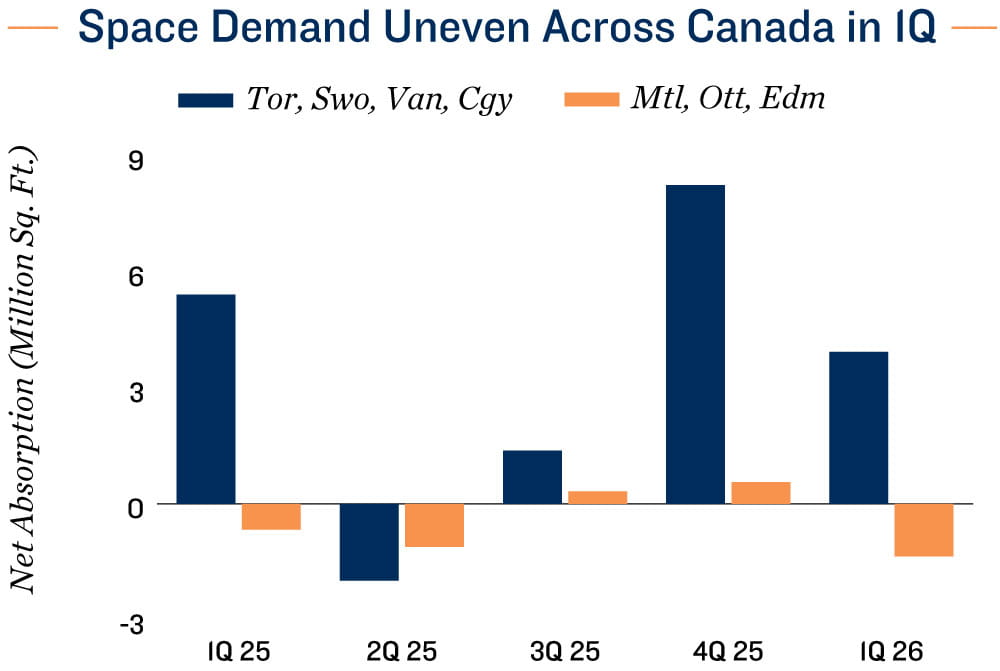
Space demand remains on upward trajectory in select markets. The latest first‑quarter data on net absorption and vacancy rates present an uneven picture of current industrial market conditions. Space demand held up in Toronto, Southwestern Ontario, Vancouver, and Calgary, while leasing activity softened across other major metros after a brief rebound in the second half of last year. In these stronger‑performing markets, tenants have largely looked past trade‑related uncertainty, with leasing decisions increasingly driven by underlying fundamentals such as population growth, supply‑chain reconfiguration, and infrastructure investment. This has translated into improved leasing momentum, particularly for large‑format space, as logistics, distribution, and energy‑related users moved forward with expansion plans.
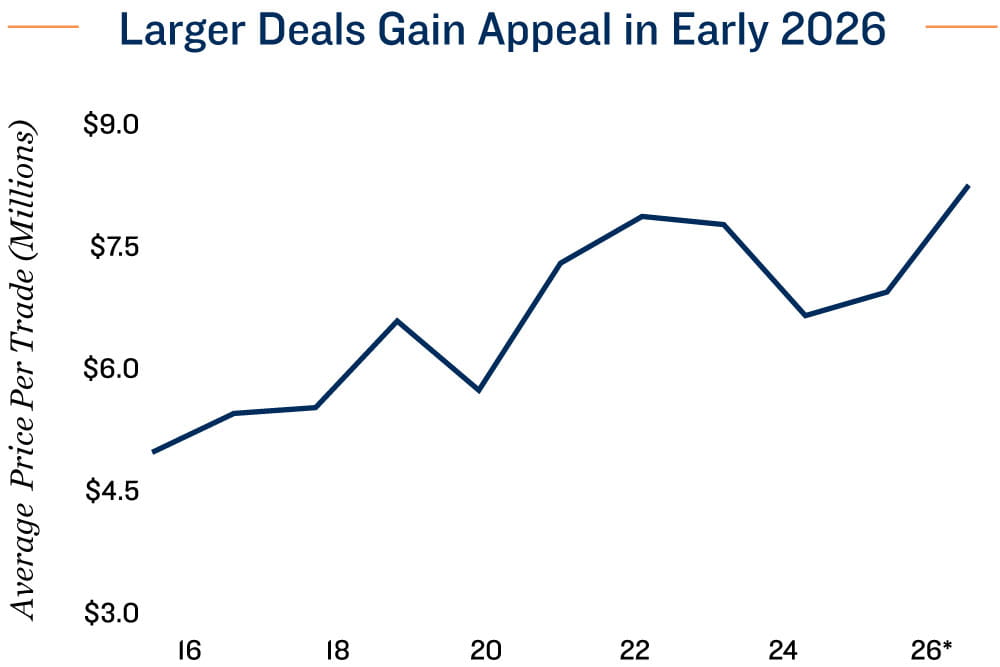
Buyer confidence rising as large-bay properties regain appeal. Preliminary sales data indicate that the average price rose per transaction to approximately $8.2 million in the first quarter, up from $6.9 million last year and $6.6 million in 2024. This increase suggests that buyers began gravitating toward larger, higher-quality assets earlier this year, reflecting a renewed appetite for scale, stabilized income streams, and best-in-class product. The shift points to a gradual improvement in investor confidence, underpinned by solid leasing momentum in select metros and growing conviction that demand for institutional‑quality industrial space is recovering.
* Through 1Q
Sources: Marcus & Millichap Research Services; Altus Data Solutions; Capital Economics; CoStar
Group, Inc.; Oxford Economics; Statistics Canada
TO READ THE FULL ARTICLE