Research Brief
Canada Housing
April 2026

Housing Outlook Softening for Now,
but Strengthening Longer Term
Residential markets continue to face risks. Canada’s housing market showed limited momentum in March, with home sales essentially flat month-over-month and remaining below seasonal norms. Weaker demand has been evident through the first quarter, with sales down year-over-year and price growth subdued as challenging conditions persist across most regions. While inventory levels remain near long term averages, cautious buyer sentiment has reduced upward pressure on pricing. Importantly, this moderation reflects a more fragile economic backdrop, where rising global uncertainty — particularly from tensions in the Middle East — has added volatility to inflation and borrowing costs. While underlying fundamentals such as population growth and pent-up demand remain supportive, near-term risks continue to weigh on market confidence.
War pressures drive rate volatility. Geopolitical dynamics have had a direct impact on interest rates, with heightened inflation concerns pushing bond yields higher through March and leading to a corresponding increase in fixed mortgage rates. This rate spike has likely kept some prospective buyers on the sidelines during what is typically the most active period of the year, as many wait for improved financing conditions. That said, there are early signs that these pressures may prove temporary. As tensions in the Middle East begin to ease, bond yields have already started to retreat from recent peaks, suggesting that mortgage rates could follow suit in the coming months. If sustained, this moderation in borrowing costs could help reengage buyers over the second half of 2026.
Commercial Real Estate Outlook
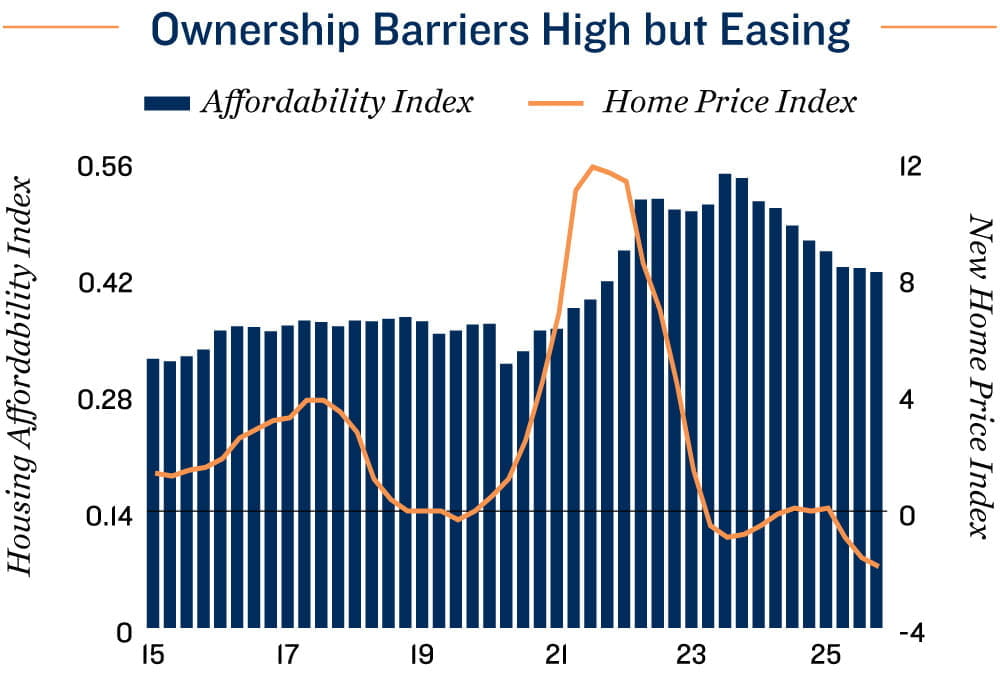
Multifamily softness emerges, yet long-term outlook is sound. While Canada’s purpose-built rental sector is showing signs of near-term softening, the shift reflects cyclical pressures rather than structural weakness. Vacancy rates are expected to rise through 2026 to just below 4 per cent — the highest level in over two decades — as a surge in new supply coincides with near-zero population growth driven by tighter immigration policies. This has eased the extreme tightness seen in recent years and tempered rent growth in some markets. However, these dynamics are likely temporary. Ongoing homeownership affordability challenges — marked by elevated prices and a still-restrictive rate environment — are keeping many households in the rental market longer. Combined with decades of underbuilding, this continues to support a strong long-term outlook for Canada’s multifamily sector, even as fundamentals normalize in the near term
Population decline weighs on demand, but expected to recover. Canada’s population contracted year-over-year in the first quarter of 2026 — down 0.2 per cent — marking the first decline on record and reflecting tighter immigration policies. As a key demand driver for residential real estate, this slowdown is weighing on both homeownership and rental markets, contributing to softer absorption and reduced sales activity. However, this pressure is expected to be temporary. Population growth, which has historically been a strong tailwind for housing demand across Canada, is forecast to return to long-term averages by 2028. As a result, while fundamentals are softening now, the longer-term outlook remains intact.

* Through April 15
Sources: Marcus & Millichap Research Services; Altus Data Solutions; Capital Economics; CMHC;
CoStar Group, Inc.; CREA; Oxford Economics; Statistics Canada
TO READ THE FULL ARTICLE