Research Brief
Canada Employment
April 2026

Softer Job Market Meets
Resilient Commercial Real Estate Sector
Labour market steadies after a shaky start to the year. Canada’s job market showed modest signs of stabilization in March, with employment rising by 14,000 positions after a combined loss of 109,000 jobs over the first two months of the year. The gain was weaker than expected and reflected a limited rebound in weather-sensitive sectors, with only modest hiring in construction and outright declines in retail and hospitality. Population growth ticked up slightly to 11,200, its fastest pace in four months, while the participation rate held steady at 64.9 per cent. As a result, labour force growth broadly matched employment gains, leaving the unemployment rate unchanged at 6.7 per cent. While headline job growth improved, the overall picture remains one of a labour market lacking meaningful momentum.
Central bank to remain on hold. Current labour market conditions are unlikely to prompt a shift in monetary policy. Hiring trends remain uneven across sectors, while underlying annual wage growth — when adjusted for compositional effects — is holding near 3.6 per cent, broadly consistent with easing inflation. Meanwhile, recent declines in oil prices reduce the likelihood of runaway cost pressures from the energy sector, offsetting earlier strength that had supported hiring in resource-producing regions. The combination of subdued employment growth, stable unemployment, and moderating wage dynamics reinforces expectations that the Bank of Canada will remain on hold through 2026, with any policy adjustment likely to be pushed into next year.
Commercial Real Estate Outlook
Industrial properties show resilience despite tariff headwinds. Manufacturing employment rose modestly by 2,500 positions in March. That said, since January 2025 — when tariff-related uncertainties began to intensify — total manufacturing jobs have declined by roughly 3 per cent. Even so, the sector has proven more resilient than many anticipated, with employment still about 4 per cent above pre-pandemic levels. This relative stability is also evident across Canada’s industrial real estate sector. Despite elevated exposure to global trade risks, the market has recorded positive net absorption in five of the past six quarters as of March, supported by lower borrowing costs, ongoing trade diversification, and supply chain reconfiguration. As a result, the national industrial vacancy rate appears to be stabilizing just above 3.5 per cent, suggesting the sector is continuing to adjust rather than materially weakening.
Health care a key source of stability. Medical office is one of the most resilient segments of commercial real estate. Driven by the essential nature of services, government-backed funding models, and long-term demographic tailwinds, the sector has maintained steady hiring momentum since the pandemic. Total employment in health care is up 3.3 per cent year-over-year and nearly 15 per cent since 2022, reflecting both an aging population and a structural shift toward more health-conscious lifestyles among younger cohorts. These trends directly benefit medical office space, where demand remains firm due to stable tenancy profiles, needs-based occupancy, and limited sensitivity to broader economic cycles.

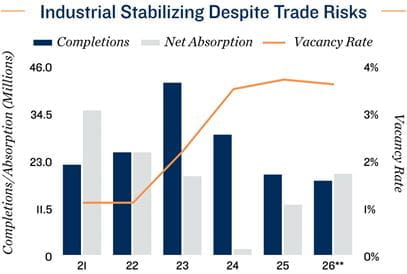
* Through March; ** Forecast
Sources: Marcus & Millichap Research Services; Altus Data Solutions; Capital Economics; CoStar
Group, Inc.; Oxford Economics; Statistics Canada
TO READ THE FULL ARTICLE