Research Brief
Key Forces Shaping CRE Outlook
March 2026

Macro Volatility Builds as CRE Maintains its Relative Appeal
Inflation risks are building beneath the surface. Producer and consumption-based price-tracking measures indicate firmer inflation dynamics than headline CPI alone would suggest.
- Inflation pressures were already emerging before the recent geopolitical developments in the Middle East, driven in part by the evolving tariff and immigration policy environment.
- Headline CPI has remained relatively tame, most recently reading 2.4 percent through February, largely reflecting cooling housing-related price growth.
- PPI has trended higher, reaching 3.4 percent in February, signaling rising input costs for manufacturers and businesses.
- This tracking metric is often a leading indicator for broader inflation measures, warranting close observation as upstream price pressures build.
- The Federal Reserve's preferred inflation gauge, PCE, stood at 2.8 percent in January, above CPI.
- Rising energy prices are widely expected to place additional pressure on inflation in the coming months.
Policy expectations shift amid uncertainty. Diminished rate-cut prospects have pushed Treasury yields higher, reflecting a more restrictive policy outlook.
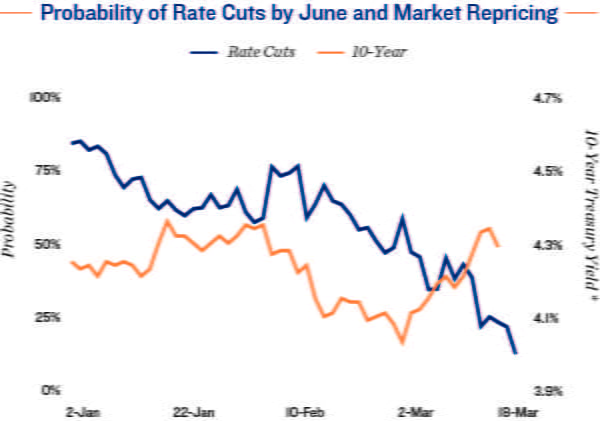
- The Federal Reserve recently held policy rates steady, while market expectations for near-term rate cuts have fallen materially, amid an uncertain economic outlook.
- The probability of a rate cut by June has dropped below 10 percent, and easing later in the year has become questionable.
- Policy outcomes hinge on conflict duration in the Middle East, with the oil prices potentially having substantial inflationary impacts on the economy.
- Treasury yields have moved higher as markets reprice the path of monetary policy, with the 5- and 10-year yields rising roughly 35 and 30 basis points, respectively, since Feb. 27.
- Despite recent upward movement, the 10-year yield remains range-bound in the 4.0 to 4.5 percent band.
Lender behavior influences CRE conditions. Steady financing backdrop, repriced assets, and inflation-resistant characteristics support CRE's positioning in a volatile environment.
- Despite potential interest rate risk, lenders have thus far maintained relatively tight spreads and ample capital availability.
- As a result, borrowing costs for most CRE assets have generally remained in the low- to mid-6 percent range, with agency multifamily financing available closer to the low-5 percent range.
- While individual loan terms continue to vary based on asset quality, location, and borrower strength, financing conditions remain broadly constructive.
- The market closed 2025 with 2.8 percent vacancy and 4.5 percent rent growth, with 2026 metrics estimated at 3.0 percent vacancy and a year-over-year rent gain of 1.3 percent.
- Although near-term economic uncertainty presents a headwind, the CRE sector should continue to offer opportunities.
- Against a backdrop of elevated equity market volatility and rich stock valuations, real estate prices have recalibrated over the past four years, reducing entry costs and bolstering yields.
- In an increasingly choppy economic climate over the short run, CRE continues to offer durability and potential inflation resilience for investors with a longer-term horizon.
* Through March 16
Sources: Marcus & Millichap Research Services; Bureau of Labor Statistics; CME Group; Costar,
Inc.; Federal Reserve; Real Capital Analytics; U.S. Energy Information Administration
TO READ THE FULL ARTICLE