Research Brief
Iran Conflict
March 2026

Market Adjustments Intensify While CRE Performance Remains Steady
Geopolitical conflict disrupts energy flows. The blockade at a key maritime choke point is limiting global energy transit, elevating price volatility, and introducing broad uncertainty.
- Military action in Iran has disrupted oil and liquid natural gas trade flows through the Strait of Hormuz, creating immediate supply constraints and wide price fluctuations.
- The blockade has curtailed roughly 20 percent of global oil and LNG shipments and disrupted other key commodities.
- The Middle East supplied just over 23 percent of non-Chinese primary aluminum output in 2025 — much of it exported via the strait — and roughly one‑third of global fertilizer trade also moves through the corridor.
- Commodity prices have risen sharply, with frequent intraday swings amid fluid conditions and constrained logistics.
- WTI crude peaked at $119 per barrel on March 9 before retreating to the high-$80 range amid prospects for de-escalation and the IEA’s release of 400 million barrels from strategic reserves.
Inflation risk and policy reassessment come to the forefront. Energy-driven inflation is restraining expectations for easing monetary policy, reshaping potential GDP outcomes in 2026.
- Higher energy costs threaten to raise food prices, disrupt supply chains, and weigh on business and consumer confidence.
- This pressure complicates central bank policy, raising the likelihood that the Federal Reserve keeps rates higher for longer.
- Wall Street has revised its outlook from expecting two to three rate cuts in 2026 to anticipating just one.
- In response, treasury yields have already moved higher, with the five-year and 10-year Treasurys rising roughly 20 to 30 basis points since late February
- Macroeconomic outcomes now hinge on conflict duration, with a short disruption implying mild effects.
- A prolonged or infrastructure-damaging scenario could potentially trim 20 to 100 basis points from 2026 GDP growth and push inflation toward the 3 to 4 percent range.
Limited U.S. CRE impact amid broader volatility. The conflict's economic spillovers are expected to have only modest, uneven effects on domestic fundamentals across property types.
- Industrial demand may soften slightly as trade disruptions and transportation constraints pressure the movement of goods.
- Retail properties could experience modest pullbacks in discretionary spending, as higher gasoline prices and increased caution weigh on household spending and tenant demand.
- Apartment and office demand could see minimal, primarily indirect effects unless business sentiment weakens markedly, potentially slowing job creation.
- An elevated interest rate environment may restrain investment activity, though heightened equity market volatility could redirect capital toward commercial real estate to diversify and stabilize investor portfolios.
- Built-in rent escalations and shorter lease terms in property types such as multifamily and self-storage enable faster mark-to-market, particularly in a high-inflation climate.
- Heightened macro uncertainty can reallocate capital toward CRE as a portfolio stabilizer, offsetting slower deal flow driven by higher borrowing costs and underscoring the relative durability of commercial real estate assets.
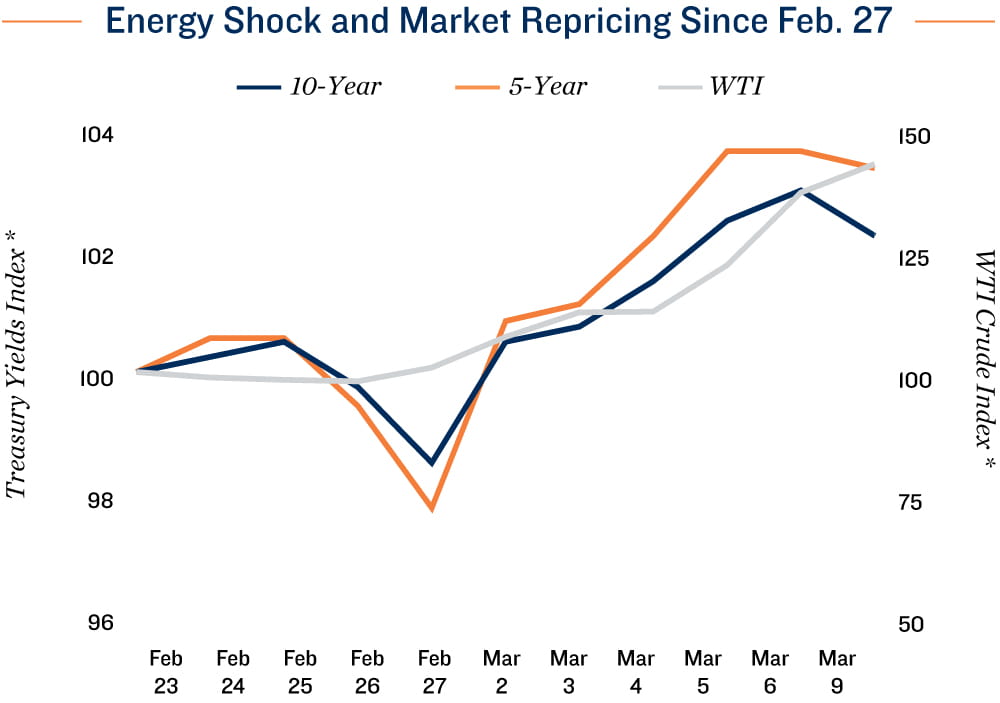
* Baseline, 100 = Feb. 23, 2026
Sources: Marcus & Millichap Research Services; Blue Chip; Capital Economics; CME Group; Costar,
Inc.; Federal Reserve; Forbes; International Aluminum Institute; JPMorgan; KPMG; Morgan
Stanley; Real Capital Analytics; S&P Global; U.S. Energy Information Administration
TO READ THE FULL ARTICLE