Research Brief
Inflation
March 2026

Inflation Stable Ahead of Oil Shock,
Complicating Spending and Leasing
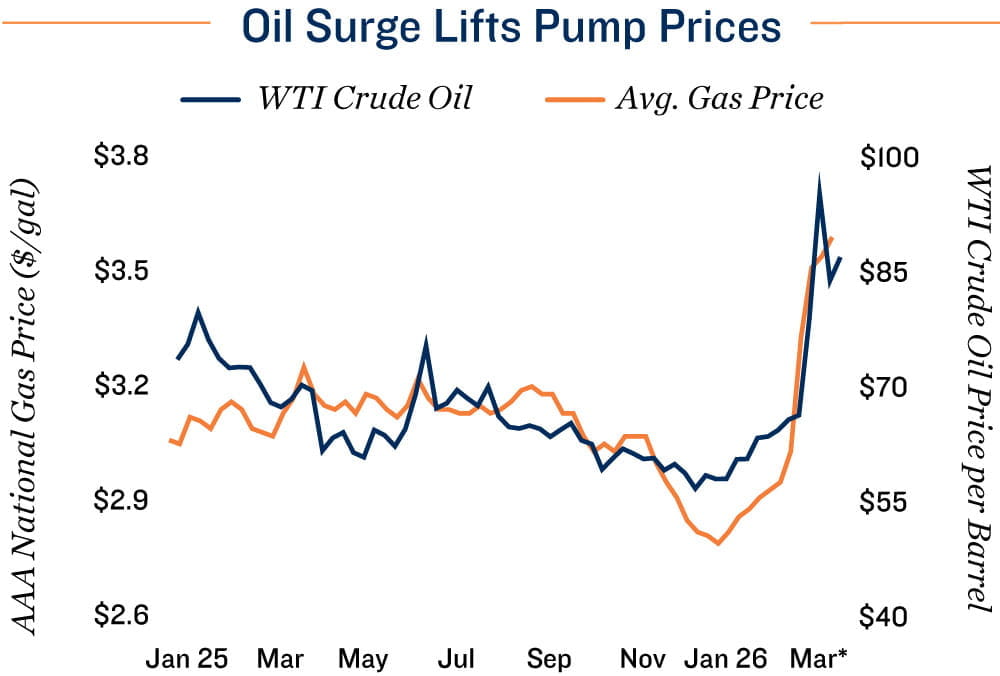
such as food. For the Federal Reserve, the key question is how much of that shock reaches core inflation, which usually rises less than headline as higher gas and food costs squeeze spending elsewhere.
Higher fuel costs test consumer spending. Gasoline prices respond quickly to oil spikes, though the hit to household budgets will depend in part on the conflict’s duration, with some households able to cushion the initial strain through savings. If prices remain elevated, the pressure will likely build most in car-dependent suburban markets, particularly across the South and West. Rising fuel costs could also push up food prices, prompting some middle- and lower-income households to cut back on dining out and shift more spending to groceries. Higher-income consumers should remain better able to absorb the shock, potentially supporting full-service restaurants, which the International Franchise Association expects to outpace quick-service chains in sales growth in 2026 for the first time since the pandemic.
Tariffs persist, but goods inflation stays soft. Although the Supreme Court struck down the IEEPA tariffs, the administration quickly imposed a Section 122 surcharge, keeping trade costs elevated. Even so, core goods inflation remained muted in February, up 0.1 percent month-over-month. Apparel and small appliances showed firmer pass-through, but declines in used vehicles and softer pricing in other discretionary items held down overall goods inflation. Some trade corridors could still benefit from the ruling, as many non-USMCA goods from Canada and Mexico now face a 10 percent surcharge rather than the prior 25 percent IEEPA tariff. That may support industrial demand in inland distribution hubs and border markets such as El Paso, where leasing hit a record 4.7 million square feet in 2025, while record construction in McAllen and Laredo suggests future growth.
Memory shortages lift electronics cost. Consumer tech could face more pressure after computer software and accessories prices rose 6.5 percent in February. AI-driven memory demand has pushed prices higher, while Micron’s exit from its Crucial consumer business signals tighter supply for mainstream devices and a tougher outlook for PC and smartphone shipments. Higher replacement costs may shift some demand toward refurbished devices, trade-ins, and repair services. That could support electronics resale and repair tenants, including PayMore, which plans to open 96 stores in 2026, and Batteries Plus, which opened 63 stores in 2025.
2.4% |
2.5% |
|
Increase in Headline |
Increase in Core CPI |
* Through March 11, 2026
Sources: Marcus & Millichap Research Services; Bureau of Labor Statistics; Federal Reserve; CoStar
Group, Inc.; RealPage, Inc.
TO READ THE FULL ARTICLE