Research Brief
Canada Monetary Policy
March 2026

Bank Holds as Global Conflict Complicates
Inflation and Interest Rate Outlook
Central bank maintains policy stance. The Bank of Canada held its policy rate at 2.25 per cent in March, citing a balance of weaker domestic economic conditions and rising inflation risks. While inflation has eased to 1.8 per cent and core measures are now close to the Bank’s 2 per cent target, recent economic data point to slowing momentum. Canada’s GDP contracted in the fourth quarter, employment losses early in 2026 have surpassed 100,000 positions, and exports remain weak amid ongoing tariff uncertainty. Meanwhile, escalating conflict in the Middle East has driven oil and natural gas prices higher, raising the risk of renewed energy-driven inflation and increased volatility in financial markets. With growth risks tilted to the downside but inflation risks rising due to higher energy costs, the Bank kept rates unchanged while it continues to monitor the economic impacts of global trade tensions and the evolving geopolitical environment.
Monetary policy outlook is evolving. Cooling inflation, alongside a weakening domestic economy, had been strengthening the case for additional easing from the Bank of Canada. In addition to the GDP contraction ending last year and a weak labour market at the start of 2026, first-quarter GDP growth is tracking near a 1 per cent annualized pace. In most circumstances, this combination would support the case for rate cuts. However, the escalating conflict in the Middle East has complicated that outlook by raising the risk of renewedenergy-driven inflation. While expectations for further easing have diminished, the likelihood of rate hikes — despite some market pricing — appears limited, given the fragile state of the economy.
Commercial Real Estate Outlook
Bond market trends influencing CRE activity. As economic indicators softened through 2025, bond yields declined, with the 5-year rate hovering near 2.75 per cent for much of the latter part of the year. This stability improved visibility on borrowing costs, helping narrow bid-ask spreads. It also supported underwriting conditions, contributing to a rebound in investment activity. By the fourth quarter, both transactions and dollar volume had risen above their trailing 10-year averages. Yields briefly increased in early 2026 before falling amid weak labour and GDP data. However, the recent conflict in the Middle East has pushed oil prices higher and lifted inflation expectations, sending the 5-year yield to around 3 per cent. While investment momentum is expected to persist through 2026, renewed bond market volatility could slow the pace of recovery
Investors returning amid improving conditions. Commercial real estate investment was stable last year, though performance varied across asset types. Retail and hotel assets posted the strongest gains, with investment volume rising. Retail’s increase reflects strong investor demand for necessity-based centers, where stable tenant demand and limited available supply have created a competitive environment. Hotels also saw a notable rise in transaction activity as limited supply, improving travel demand, and stronger operating fundamentals boosted investor confidence in the sector’s income potential. By contrast, investment activity in industrial, apartment, and office assets declined modestly as tariff uncertainties, tighter immigration policy, and evolving hybrid work policies weighed on deal flow.

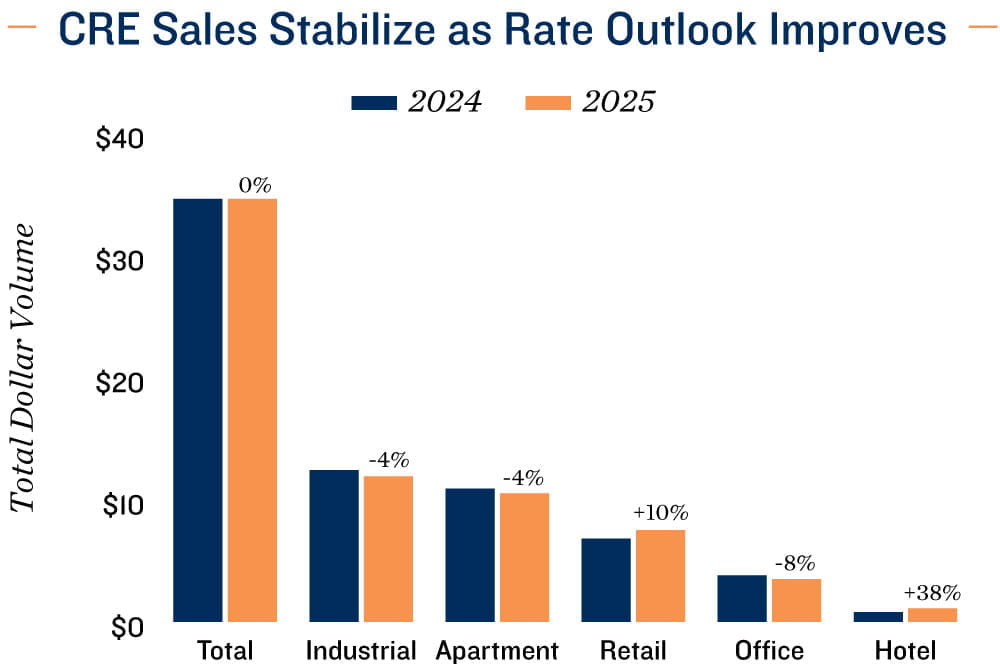
Sources: Marcus & Millichap Research Services; Altus Data Solutions; Capital Economics; CIBC;
CoStar Group, Inc.; Oxford Economics; RBC; Scotiabank; Statistics Canada; TD
TO READ THE FULL ARTICLE