Research Brief
Canada Housing
March 2026

Canada Housing Market Faces Renewed
Headwinds as Rates Reprice Higher
Housing conditions continue to soften. Canada’s housing market remained subdued in February, with sales declining 1.3 per cent monthly and activity sitting 8.1 per cent below year-ago levels. Adverse winter weather contributed to the slowdown, but underlying demand also remains soft amid affordability constraints and cautious buyer sentiment. New listings fell 3.9 percent, yet supply remains elevated relative to recent years, keeping the market balanced but tilted in favour of buyers in major metros like Toronto and Vancouver. As a result, pricing continued to soften, with the median price of a single-family home down 4.4 per cent annually and 20 per cent below its February 2022 peak. This largely reflects persistent downward pressure from higher borrowing costs and subdued demand amid tariff uncertainties and the conflict in the Middle East.
Rising bond yields threaten to further chill housing demand. Mounting geopolitical tensions in the Middle East are adding a new layer of risk to the housing outlook. Rising energy prices have pushed up bond yields, which in turn are expected to lift fixed mortgage rates in the near term. While the increase may be modest, even incremental rises in borrowing costs are likely to further erode affordability and weigh on buyer confidence. As a result, transaction activity is expected to remain subdued through the near term, with many prospective buyers continuing to delay purchases. Against this backdrop, home prices are likely to remain on a downward trajectory.
Commercial Real Estate Outlook
Apartments continue to hold as preferred build type. Residential construction showed signs of stabilization in February, with annualized starts rebounding to roughly 251,000 units following weather-related disruptions in January. That said, underlying trends remain uneven. Single-family construction has slowed markedly, falling to its lowest level in several years, while activity in the multi-unit segment continues to drive overall starts. At the same time, weak pre-construction condo sales — particularly in Ontario — are raising concerns about future project viability once the current pipeline is delivered. Higher financing costs are also weighing on both developers and buyers, suggesting that while starts may hold near current levels in the near term, downside risks are building as tighter financial conditions and soft demand begin to filter through the development cycle.
Demographics weighing on housing fundamentals. Tighter immigration policies aimed at reducing the intake of temporary residents contributed to Canada’s first annual population decline on record in early 2026, with the population contracting by approximately 0.25 per cent in the first quarter. This trend is expected to persist into 2027, easing demand across both ownership and rental markets. In the multifamily sector, this slowdown in population growth — combined with a surge in purpose-built rental completions — is softening fundamentals. The national vacancy rate is projected to rise to just below 4 per cent, up roughly 200 basis points from the 2023 low, while rent growth is expected to moderate sharply to the 1–2 per cent range, a significant pullback from the 8.4 per cent peak in 2023.

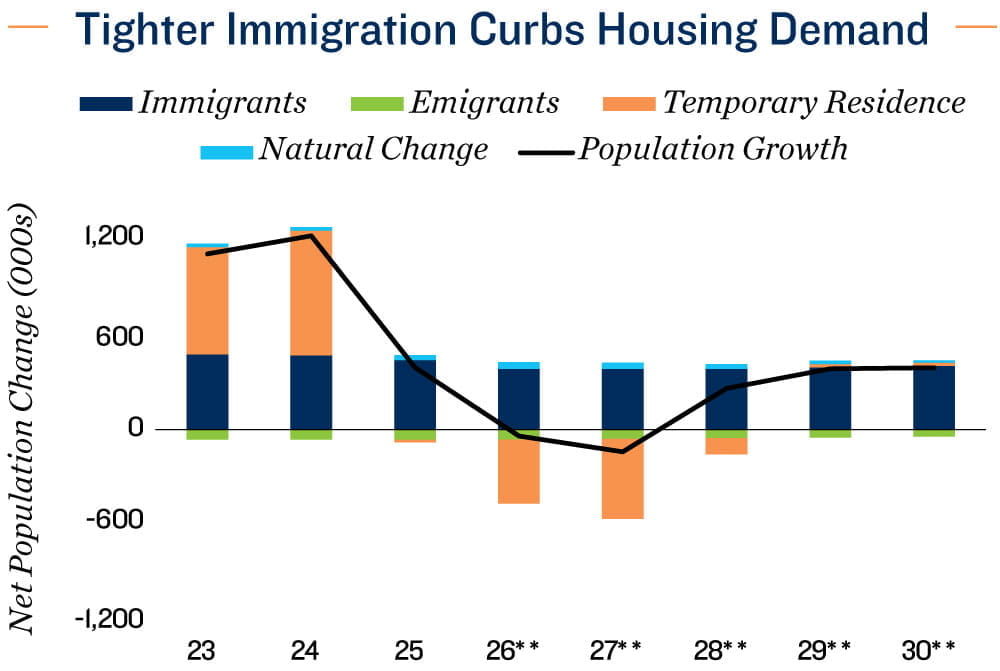
* Through February; ** Forecast provided by Oxford Economics
Sources: Marcus & Millichap Research Services; Altus Data Solutions; Capital Economics; CMHC;
CoStar Group, Inc.; CREA; Oxford Economics; Statistics Canada
TO READ THE FULL ARTICLE