Research Brief
Canada Employment
March 2026

Soft Labour Market Contrasts with
Stabilizing Office Sector
Job market momentum fades. Canada’s labour market weakened in February, with employment falling by 84,000 positions. This marks the largest monthly decline since January 2022 and pushes cumulative job losses in the first two months of 2026 above 100,000. While severe winter storms likely contributed to the monthly drop, the weakness appears broader as slower economic growth and ongoing trade uncertainty continue to dampen hiring. Manufacturing employment declined by another 9,000 positions, extending the sector’s downward trend. Wholesale and retail trade also recorded notable job losses. As employment fell, the unemployment rate rose 20 basis points to 6.7 per cent, highlighting a labour market that continues to struggle for sustained momentum.
Monetary policy faces competing pressures. Before the recent escalation in the Middle East, incoming data had increasingly supported the case for another Bank of Canada rate cut. Fourth-quarter GDP contracted, core inflation had been easing, and labour market conditions were soft — all pointing to a central bank with room to provide additional support. February’s employment report reinforces that narrative. However, the Iran conflict has complicated the outlook by pushing oil prices higher and raising the risk of renewed energy-driven inflation, squashing the likelihood of any additional easing. Even so, Canada’s exposure to the conflict is relatively limited. Combined with a soft economic backdrop and weak labour market conditions, this suggests the Bank of Canada is likely to remain on hold rather than pivot toward renewed tightening.
Commercial Real Estate Outlook
Office performance improving amid evolving dynamics. Canada’s office sector is beginning to show early signs of stabilization after several years of rising vacancy. National office vacancy increased by more than 500 basis points between 2019 and 2024, to roughly 14 per cent. But it began to stabilize last year, declining by about 20 basis points in 2025. A key driver has been the supply side, as the sector’s historic construction cycle has largely run its course. The development pipeline peaked at roughly 20 million square feet in 2020 but has since fallen sharply to about 3 million square feet as of the first quarter of 2026. Demand is also improving, with net absorption positive in three of last year’s four quarters as return-to-office policies pushed weekday occupancy to roughly 85 per cent. Strong office-using employment growth is also supporting demand, rising nearly 30 per cent since 2016 compared with a 17 per cent increase in total employment.
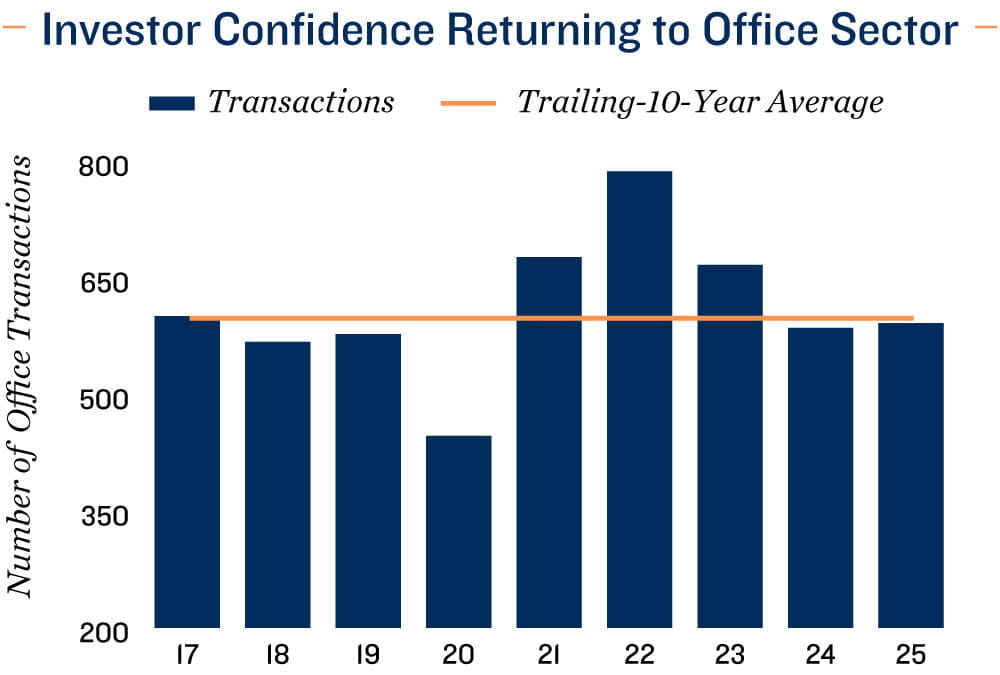
Investors eye select office assets. Investment activity in Canada’s office sector is also recovering. Property sales increased in 2025 as stabilizing fundamentals, clearer interest rate expectations, and reset property values helped revive buyer confidence. Cap rates relative to borrowing costs are now offering more attractive entry points for investors positioning ahead of the next growth cycle. This has helped narrow bid-ask spreads and brought more assets to market. Even so, demand remains highly selective, with investors primarily targeting core, high-quality assets. This was evident in the 27 per cent jump in sales valued at over $20 million last year, alongside a 40 per cent decline in deals valued at $10 million to $20 million.

* Forecast provided by Oxford Economics
Sources: Marcus & Millichap Research Services; Altus Data Solutions; Capital Economics; CoStar
Group, Inc.; Oxford Economics; Statistics Canada
TO READ THE FULL ARTICLE