Research Brief
Tariff Outlook
February 2026

Ongoing Tariff Volatility Sustains Economic
Uncertainty, Yet CRE Remains Resilient
Tariff policies shift amid recent reversals. A series of legal decisions and executive-level actions have altered effective tariff rates and created a rapidly evolving policy landscape.
- The Supreme Court struck down tariffs enacted under the International Emergency Economic Powers Act (IEEPA), ruling that the statute does not authorize unilateral executive action to impose tariff measures.
- The decision invalidated many of the tariffs imposed in 2025, reducing the effective tariff rate by roughly 700 basis points.
- Shortly after the ruling, the administration implemented a separate 10 percent global tariff, with a stated intention to raise the rate to 15 percent
- These new tariffs are temporary measures set to expire after 150 days unless extended by Congress.
- While duties on several key industrial materials remain unchanged at elevated levels, many imports from Canada and Mexico continue to enter tariff-free under the USMCA, though the agreement's upcoming July renewal adds uncertainty.
Uncertainty disrupts key drivers of space demand. Hiring, household formation, and consumer spending have moderated as consumers and businesses adapt to shifting trade measures.
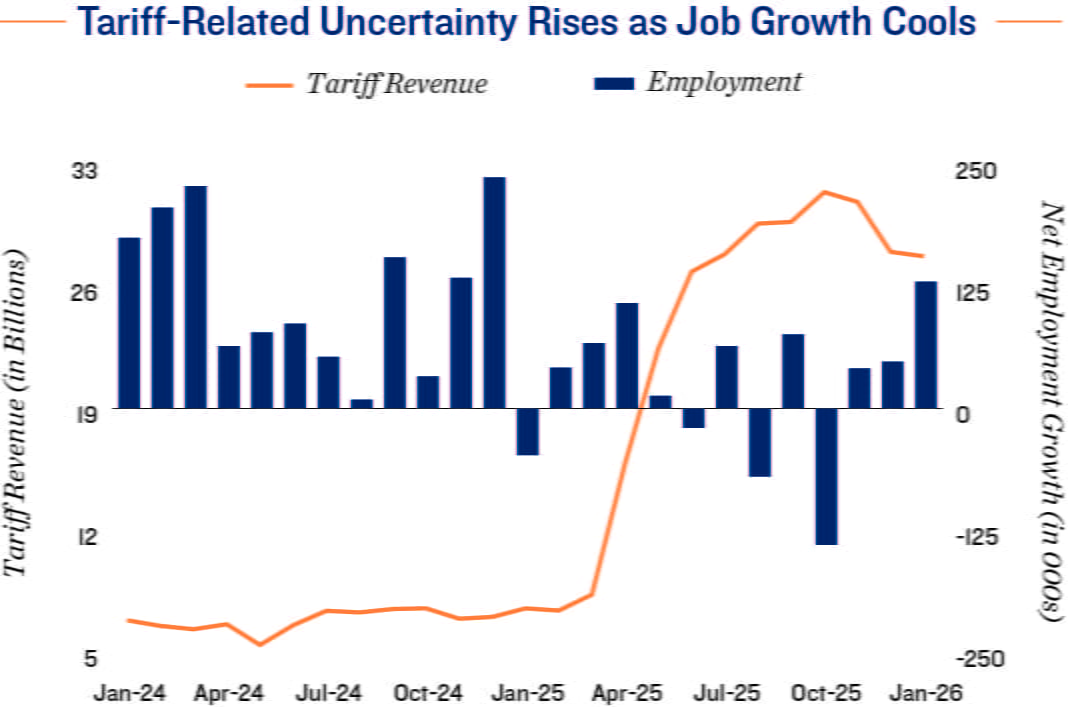
- Heightened tariff-related uncertainty has become a key economic drag, exerting a greater impact than the direct financial cost of the tariffs themselves in certain ways.
- Firms have responded cautiously, with job creation in 2025 falling 88 percent from the prior year, averaging only 1,500 net new positions per month since May of 2025.
- Slower hiring has tempered household formation, contributing to negative net apartment absorption at the end of 2025.
- Softening job growth and weaker household formation have also weighed on consumer spending, with real core retail sales only up 0.4 percent year-over-year in December 2025.
- As a result, these trends are restraining demand for retail and industrial space.
Despite headwinds, the CRE outlook remains optimistic. Sustained economic expansion and a tightening supply pipeline support near-term stability with potential long-run upside.
- Amid policy volatility, tariffs shaved an estimated 0.2 percentage points from GDP in 2025, yet the U.S. economy still grew by 2.2 percent.
- Job creation has slowed significantly but remains positive year over-year, supporting continued, albeit moderate, demand across the major CRE property types.
- Additionally, elevated construction costs stemming from tariffs have and most likely will continue to constrain new supply.
- As a result, CRE vacancy rates are expected to remain relatively stable, with fundamentals potentially strengthening once uncertainty fades.
Sources: Marcus & Millichap Research Services; Bureau of Labor Statistics; Costar, Inc.; RealPage,
Inc.; The Budget Lab at Yale; U.S. Bureau of Economic Analysis; U.S. Census Bureau
TO READ THE FULL ARTICLE